This week is a very interesting one when it comes to access of ancient DNA coming from the eastern steppes. We got a 2-for-1 combo deal with ancient DNA from the Xiongnu period and the Goktürk period.
Ancient DNA from Xiongnu cemeteries in Western Mongolia
The other day raw data for an upcoming article headed by Choongwon Jeong, who also was the lead author of the 2020 article “A Dynamic 6,000-Year Genetic History of Eurasia’s Eastern Steppe” which currently is one of the most significant articles to have come out in relation to the topic of the eastern steppes during the metal ages was uploaded to Edmond (the Open Research Data Repository of the Max Planck Society).
Description:
This collection includes the EIGENSTRAT format genotype data of 17 ancient individuals for the 1240K SNP panel. The individuals are newly analyzed in the study "Genetic population structure of the Xiongnu Empire at imperial and local scales" and are from two Xiongnu-period archaeological sites in Mongolia: TAK(Takhiltyn Khotgor) and SBB(Shombuuzyn Belchir).
The raw data is accessible here:
Data for "Genetic population structure of the Xiongnu Empire at imperial and local scales" - Edmond
Davidski from the Eurogenes blog has converted these samples to Global25 coordinates, which you can access here.
https://drive.google.com/file/d/1PC-N4dJr3pWynJIYKdAYzZWwXhJug5e-/view?usp=share_link
This means that you can now utilize these samples with the various Vahaduo tools, which you can do here:
Visit the Eurogenes blog for the Global25 coordinates:
Eurogenes Blog: Getting the most out of the Global25
I will discuss the genetic aspect in a bit, but first I will go over the two sites these samples come from. Below is a map which showcases the two sites, Shombuuzyn Belchir and Takhiltyn Khotgor being site 1 and 2 on the map respectively [1].
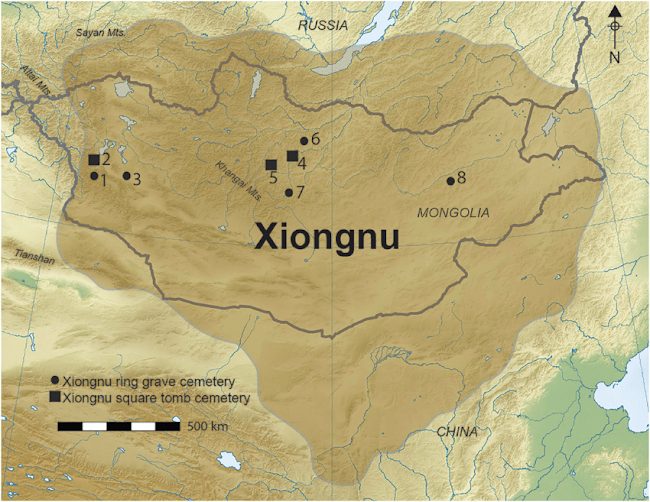
Takhiltyn Khotgor is an interesting site because it is one of the few Xiongnu elite cemeteries which are present in western Mongolia, as most of the large cemeteries are in Central Mongolia and the Transbaikal region [2].
Now I think that due to the limited information we have about the Xiongnu empire a lot of opinions about “Xiongnu elites” have been pulled right out of thin air. Reading some historian’s works you’d get the impression that it is certain that the Xiongnu elites belonged to a singular ethnic group, whether it’s Yeniseian speaking, Turkic speaking, Iranian speaking. Personally I see no real evidence for this in primary sources, in fact I see no evidence that the founding tribes of the Xiongnu confederation themselves belonged to a single ethnolinguistic group, let alone the elites at an imperial or local level of the imperial period.
Nevertheless getting genomic data from such elite burials will be very informative and could help to confirm or debunk the many many claims that float around about the Xiongnu and the elite strata of their society.
The arrangement and components of tomb complexes at Takhiltyn Khotgor, as well as the
contents of the main tombs, closely resemble elite Xiongnu cemeteries found elsewhere. The
elite graves here are undoubtedly associated with the elite imperial culture of the Xiongnu
polity and thus may be considered within the limits of the empire. Despite the consistencies
in mortuary remains for the elite, evidence arises in the satellite burials of differentiation from
standard Xiongnu customs. Interments in stone cists such as THL-64-1 and THL-64-2 are
seldom found in other Xiongnu cemeteries, and the flexed legs of these two graves and THL25-1 deviate from the prevailing custom of fully stretched supine burials in Xiongnu graves
(Törbat 2004). The most significant difference is the surface demarcations. The small tight
cluster of stones over the grave pit differs greatly from the tradition of stone rings. It is not
clear what these variations indicate, but it may relate to either local variations of the Altai or
perhaps a social group not yet delineated within the greater corpus of Xiongnu remains. Further excavations of Xiongnu graves, especially outside the large elite cemeteries, will need to be
conducted in the area of Khovd aimag in order to further clarify this issue.

Crescent sun disc from grave 64 at Takhiltyn Khotgor
Shombuuzyn Belchir is a bit less extravagant than Takhyltin Khotgor. The burials here generally fall in line with the typical Xiongnu burial traditions of Central and eastern Mongolia.
The radiocarbon dates for these sites range in between 50 BC and 100 AD for Takhyltin Khotgor and Shumbuulzyn Belchir [3].
This is an interesting period during the Xiongnu empire as it falls in the range of the first Xiongnu civil war, where we see Zhizhi Chanyu making his base around the Altai region. Presumably, this was after the defeat of the rebelling Hujie Chanyu, the Hujie being one of the tribes of the Xiongnu most likely located in the southern Altai region.
Bernshtam interpreted the historical records as indicating that Zhizhi Chanyu made his base around the “celestial mountain” as Zhizhi making his base around the Tian Shan mountains, and that this migration was the movement of Huns into Central Asia. However, based on the description it seems far more likely that the “celestial mountain” refers to the Altai, and Zhizhi Chanyu’s army by the time of reaching the Kangju was only a few thousand men strong, he was also defeated in battle and slain in this area by the Han [4].
Later on the Xiongnu split into a Northern Xiongnu and southern Xiongnu, and the Altai region was a core territory of the northern Xiongnu. It is here where the Northern Xiongnu were defeated at the battle of the Altai with the Northern Chanyu fleeing, which more or less ended their role as a significant political factor in the steppes. Soon after the remnants of the Northern Xiongnu were defeated by the Xianbei and incorporated into their empire.
Using Vahaduo Admixture JS, here are some models for these samples, keeping it simple. Since there are several streams of ancestry which can overlap I turned on the ADC function at 0.25 to reduce overfitting.
My friend Altvred who some of you might know from our collaboration “When did the Western Steppe Herder genetic profile form?” also had taken a look at the Y-DNA of the samples. Unfortunately there is no data on mtdna available at the moment so Y-DNA will have to do:
A few things to note here:
One thing I have been quite convinced of lately is that Proto-Turkic speakers originally were present in central-eastern Mongolia and the Transbaikal region during the period circa 500 BC - 100 BC. This is based on a combination of archaeology, linguistics and ancient DNA.
I am also convinced that C-F1756 was one of the core y-chromosome haplogroup lineages amongst these early Proto-Turkic peoples (one of being key here). Now you might say “hold up, isn’t C-F1756 a Mongolic haplogroup?” and you wouldn’t be wrong as modern distribution certainly suggests that. Many cases of C-F1756 so far also have been found in samples with a Mongolic-like autosomal profile and/or in contexts such as Xianbei or Rouran sites. C-F1756 also shows up quite a bit in samples from central-eastern Mongolia during the Xiongnu period, predominantly in the area I just highlighted as what I consider the most likely location of a Proto-Turkic urheimat. And we do have samples with C-F1756 in early medieval Europe in Khazar, Avar and Hungarian conqueror period contexts which predate the presence of Mongols in Europe.
But the lineage is certainly not frequently found amongst medieval Turkic peoples. I think that there are multiple layers of y-chromosome haplogroup introgression that ultimately brought the C-F1756 frequency amongst Turks down by a significant margin, with one key event being the Xiongnu collapse and the interactions between native Altai Scythians and new eastern migrants in the ensuing periods. I am working on something regarding my opinions on the Turkic urheimat, which will cover this exact topic too but in more detail and with a lot more evidence for my claims. However it is not going to be published soon, there is still much I need to work out.
The fact that C-F1756 was quite significantly present amongst the males in this sampleset is interesting, and could indicate what I suggested earlier: C-F1756 was significantly present amongst early Turkic speaking peoples until they started mixing with local Scythian remnants around the Altai region, which lead to a replacement of C-F1756 by lineages such as R-Z93, Q1b, J2 etc. Later on as Turkic people started expanding more and more lineages introgressed into their population.
What I also wonder is if the C-F1756 samples are all related in the sense that we have sampled a dynasty or if we just have samples that arose from a common population where C-F1756 was a common lineage hence it being present at both sites. Given that Shombuuzyn Belchir doesn’t seem to be an elite site in particular, and that Han-related ancestry isn’t ubiquitous it might be the second scenario.
SB0001 and SB0010 are interesting samples because they highlight how quickly an autosomal profile can shift. For instance we have many samples with western/south siberian lineages that have a near entire east Asian profile. Here we have a sample which is over 50% Eastern Scythian related yet had C-F1756 as a paternal lineage.
Unfortunately since the article is not out yet we have no burial contexts for the samples and it is hard to figure out who is who exactly. When it comes to Takhiltyn Khotgor, there are apparently over a hundred burials present at the site and there are several square tombs with an elite connotation. Most of the information in articles seems to be in regards to the later excavations and if the TAK samples come from samples of those excavations, I think there is decent room to speculate about the burial context of the samples at Takhyltin Khotgor.
For instance it would be interesting to note that tomb 82 and tomb 64, which are the elite square-shaped tombs, both contained women, with burial 82 being dubbed “the princess tomb” [5].
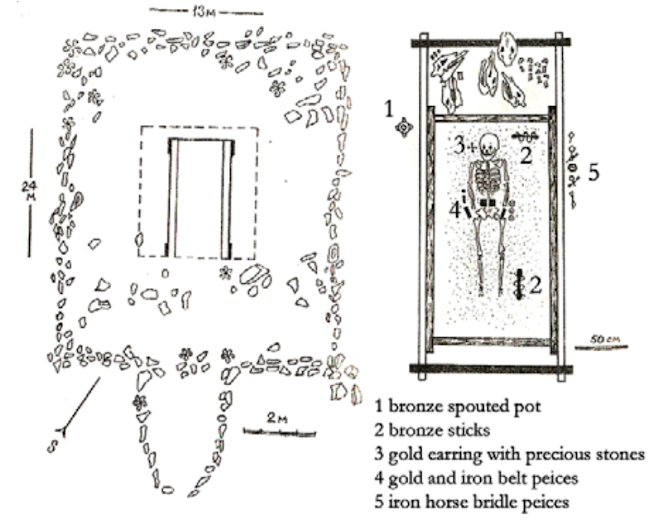
Tomb 82 of Takhiltyn Khotgor
Tomb 64 contained an older woman which had given birth before based on her pelvis remains.
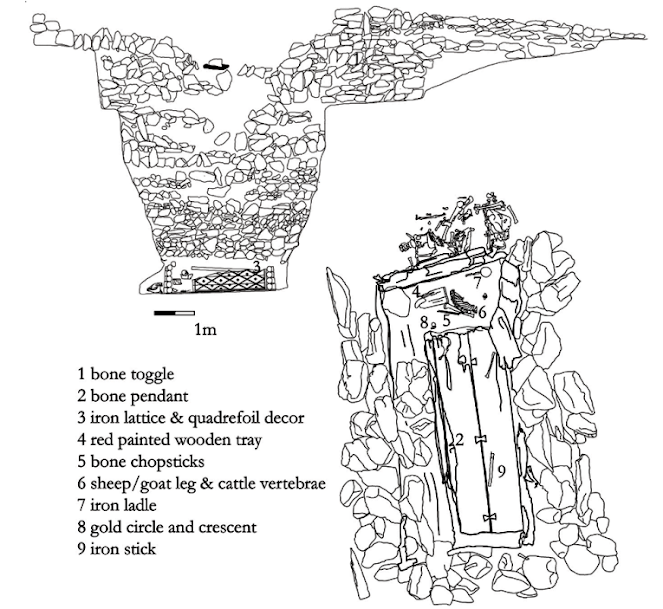
Tomb 64 of Takhiltyn Khotgor
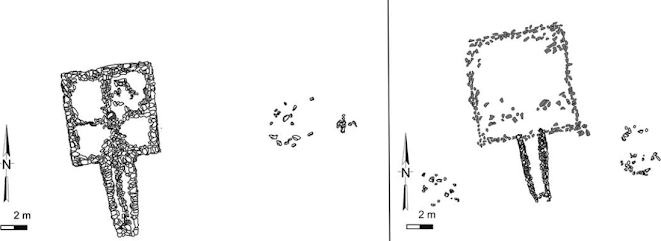
Aerial view of Tomb 64 and tomb 82 respectively.
I suspect that the TAK002 sample might come from one of these elite burials as this sample belongs to a woman, and her autosomal profile suggests a significant amount of Han-related ancestry. A legacy of the Heqin policy perhaps?
The satellite burials around tomb 82 and tomb 25 contain people buried in standard Xiongnu period graves, although there is some deviation as their burial position is flexed. The people in these tombs are described as having robust muscle attachments, an osteological sign of performing significant physical labour. The anthropological type seems to be related to populations of Manchuria, Baikal and central-eastern Mongolia. Perhaps the significantly amur shifted sample TAK006 comes from one of these burial contexts. From a genetic perspective there seems to be a connection between TAK006 and the samples at Shombuuzyn Belchir.
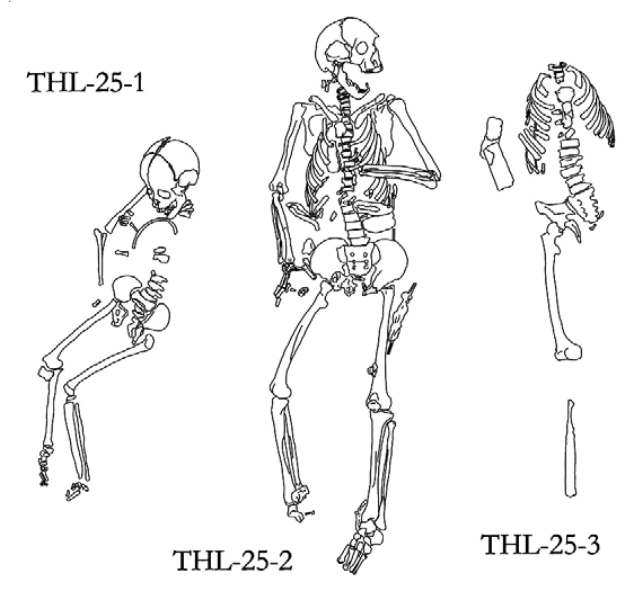
Satellite burials of tomb 25 at Takhiltyn Khotgor
I wonder if TAK008 and TAK009 samples come from these aforementioned satellite burials with deviating burial rites, as the stone lining without coffins and flexed burial positions are quite reminiscent of Eastern Scythian burial rites.

Satellite burials at tomb 64 of Takhiltyn Khotgor
That said it might be that these samples come from completely different burials. We will find out eventually when the article comes out.
From a genetic perspective TAK008 and TAK009 are two samples which are highly interesting to me because they have a rather distinctive profile. In general you can divide “westerners” amongst the Xiongnu samples into three clusters:
Scytho-Siberian cluster.
The first one is the Scytho-Siberian cluster, which are samples with an autosomal profile similar to either Scythians from the Altai and Tian Shan regions. The steppes of the Altai mountain region were home to Scytho-Siberians during the first millennium b.c, and several of the eastern Scythian material cultures have full continuity into the first century BC, more than a century after being under Xiongnu rule. Some samples however resemble Saka from the Tian Shan region, which can be seen as a two-way mixture of Eastern Scythians and Southern Central Asians.
Southern Central Asian cluster
The second cluster are samples in which the dominant factor is southern Central Asian ancestry, although there is variable complex mixture with iron age steppe nomads going on as well. The source of this ancestry primarily seems to be the Tian Shan Saka kind but some samples do seem to have Sarmatian ancestry too, which is interesting. There really is only one area where all of this comes together, and that is the Kangju state. A state founded by a nomadic population centered around Sogdia. This state was also an ally of the Xiongnu, although the relation was loose at times so we have a historic precedent for their presence amongst Xiongnu sites in Mongolia.
East Xinjiang cluster
The third cluster is a rather unique one. Amongst Xiongnu period sites there is a consistent appearance of a population with partial ancestry from Scytho-Siberians, southern Central Asians, upper Yellow River inhabitants and also having quite a high amount of West-Siberian hunter-gatherer related ancestry. The samples with this profile also often had y-chromosome R1b-PH155, which was first found in the Xiaohe-Gumugou samples known for their Tarim Mummies. R1b-PH155 was also significantly present at Zaghunluq, an iron age site also known for their Tarim mummies, such as Cherchen man. The autosomal profiles of the samples in this cluster are reminiscent of those found in early iron age sites in Xinjiang such as Zaghunluq, although they can best be described as a mixture of Scytho-Siberians and Iron age Xinjiang. The most likely area for the development of this profile is the Eastern Xinjiang region as archaeology suggests the formation of a nomadic material culture of mixed Pazyryk-related and Yanbulak origin.

Shirenzigou burial site
The samples Tak008 and Tak009 clearly belong to this third cluster based on their autosomal ancestry and Y-dna ancestry. Other samples include the two “Central Asian'' Xiongnu samples DA38 and DA41, with the latter having Y-chromosome R1b-PH155 as well. The Shirenzigou samples from the Barkol steppes fit this profile too, and are actually the reason why I dubbed it the “East Xinjiang cluster” as the earliest phases of the nomadic presence at the Shirenzigou and Heiguoliang sites predate the Xiongnu empire, and thus the presence of this cluster within Xiongnu contexts comes through the populations of the Barkol-Yiwu region.
I also suspect that these East Xinjiang cluster samples are the Yuezhi (and Wusun) based on the historical records suggesting that prior to moving to the Ili valley and Bactria the Yuezhi were present in the regions steppes of Eastern Xinjiang and Western Ganu, as well as the archaeological presence of this material culture both predating and continuing through the Xiongnu period. We know from history that several “Xiao Yuezhi” groups rather than migrating away remained under the Xiongnu, and even founded city states in modern day Xinjiang.
A few months ago I started working on a blog post which covered several of the historical peoples of the Xiongnu period that could be linked to Scythian material cultures and it is something I still haven’t finished. I currently have over 40 pages of text on this topic and honestly I am not even close to wrapping it up. I am thinking of splitting it into pieces so that it would cover several blog posts. One of them will be about the Yuezhi and their origins, and my arguments about the Yuezhi being this “East Xinjiang cluster” will be explained more thoroughly. Look at me teasing around, I didn’t mean to but these samples are hitting the topic of two WIP blog entries I have been working on at a snail’s pace.
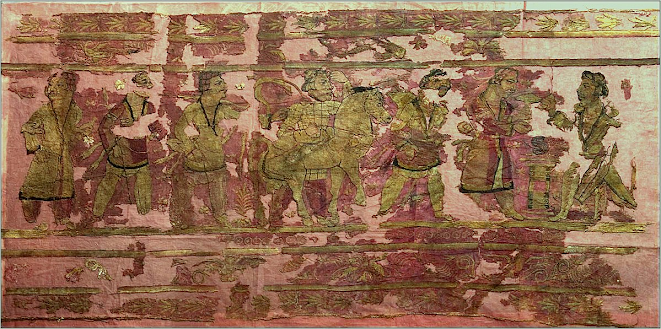
Noin-Ula tapestry, likely depicting Kushans from Central Asia
Yeniseian-related profiles however seem to be entirely lacking amongst these samples, which troubles the interpretation that “The Xiongnu” or their elites were Yeniseian speakers. Aside from proposed loanwords and etymologies, the most secure argument for a Yeniseian presence amongst the Xiongnu is an attested phrase of the Jié people, which were one of the tribes of the Xiongnu which formed a short-lived state called Later Zhao under Shi Le during the period of Sixteen Kingdoms of the Five Barbarians. The phrase was recorded by the Kuchean monk Foutudeng, in chinese characters, glossed with a chinese translation:
秀支 替戾剛 僕谷 劬禿當
army - go out - Liu Yao's barbarian title - capture
Which according to Pulleyblank should be rendered as the following in Middle Chinese [6]:
i̯u-ci̯e - tʰei-let/lei-kɑŋ - bok/buk-kuk/yo - ɡi̯u̯o-tʰuk-tɑŋ
The Yeniseian interpretation according to Vovin [7] is as following:
“Suke t-i-r-ek-ang bok-kok k-o-t-o-kt-ang”
“Armies have gone out. [They] will catch Bokkok.”
I think the linguistic arguments behind this phrase being Yeniseian in origin are quite sensible, because it correlates with linguistic developments in Southern Yeniseian in particular [8]. This is interesting because southern Yeniseian groups such as the Arints were nomadic pastoralists living in Yurts, although their language suggests adoption of this lifestyle by way of Turkic influence, probably through the Kyrgyz [9].
The proposed Turkic etymologies from a linguistic perspective are far less sound. However, to extrapolate that the “Xiongnu language” was Yeniseian or that their elites were Yeniseians (who later language-flipped into Oghuric Turkic) based on this one group is something I find a bit baseless. It didn’t make too much sense to me to begin with because the early Xiongnu confederations were attested just north of China, and the Proto-Yeniseian homeland was considerably further north.
Empress Ashina
Last month an article about Empress Ashina was published and the genomes of her ancestry were made public yesterday.
Ancient genome of Empress Ashina reveals the Northeast Asian origin of Göktürk Khanate
Abstract:
We have unveiled the first genomic profile of the ancient Türkic royal family and Chinese historical celebrities. Our genomic analyses of Empress Ashina revealed Göktürk's Northeast Asian origin (97.7% Northeast Asian ancestry and 2.3% West Eurasian ancestry), refuting the western Eurasian origin and multiple origin hypotheses. We found Ashina shared most genetic affinity with post-Iron Age Tungusic and Mongolic Steppe pastoralists, such as Rouran, Xianbei, Khitan, and Heshui_Mohe, and showed genetic heterogeneity with other ancient Türkic people, suggesting the multiple sources of the Türkic Khanate populations. Furthermore, the limited contribution from ancient Göktürk found in modern Turkic speaking Article populations once again validates a cultural diffusion model over a demic diffusion model for the spread of Turkic languages.
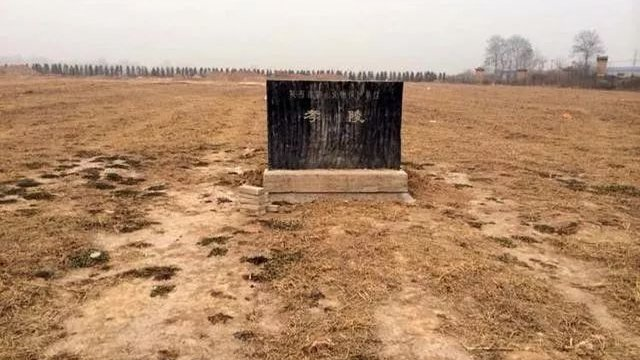
Tomb of Empress Ashina. Source.
Davidski too made coordinates of her genomes:
- A42801_scaled,0.026179,-0.41332,0.086738,-0.043928,-0.03416,-0.021196,0.00329,0.025845,-0.002454,0.012028,-0.029555,-0.01154,0.003865,-0.006881,0,0.008221,-0.002217,0.003674,-0.001257,0.02176,-0.01672,-0.00643,-0.012941,-0.005543,-0.000838
- A42801_unscaled,0.0023,-0.0407,0.023,-0.0136,-0.0111,-0.0076,0.0014,0.0112,-0.0012,0.0066,-0.0182,-0.0077,0.0026,-0.005,0,0.0062,-0.0017,0.0029,-0.001,0.0174,-0.0134,-0.0052,-0.0105,-0.0046,-0.0007
Unfortunately the coverage of the sample isn’t all too good, so I wouldn’t take the percentages of the samples too literally, using similar models as I had used for the Xiongnu samples earlier I get something like this:
Target: A42801_scaled
Distance: 3.8806% / 0.03880631
62.4 CHN_Amur_River_EN
30.4 CHN_Upper_Yellow_River_LN
7.2 RUS_Sintashta_MLBA
Target: A42801_scaled
Distance: 4.0703% / 0.04070271
38.0 MNG_Slab_Grave_EIA_1
26.8 CHN_Western_Liao_River_BA_o
26.2 CHN_Upper_Yellow_River_IA
9.0 MNG_Sagly_EIA_4
I think it possible the authors probably underestimated the degree of western ancestry as they modeled the sample with MNG_North_N as the East Eurasian source. The issue is that the MNG_North_N samples have a small amount of ANE ancestry, which more or less lines up with the amount of Sintashta/Sagly ancestry you see pop up here.
Target: A42801_scaled
Distance: 6.5378% / 0.06537781
95.2 MNG_North_N
4.8 RUS_Sintashta_MLBA
In any case it shows that the Early Turks of the Ashina clan at this time were undoubtedly significantly of eastern steppe origin. Furthermore they made rather weird claims about the spread of Turkic languages based on this sample:
“In summary, we have unveiled the first genomic profile of the ancient Türkic royal family. Our genomic analyses of EmpressAshina revealed Göktürk's Northeast Asian origin (97.7%Northeast Asian ancestry and 2.3% West Eurasian ancestry),refuting the western Eurasian origin and multiple origin hypotheses. We found Ashina shared most genetic affinitywith post‐Iron Age Tungusic and Mongolic Steppe pastoralists,such as Rouran, Xianbei, Khitan, and Heshui_Mohe, and showed genetic heterogeneity with other ancient Türkic people,suggesting the multiple sources of the Türkic Khanatepopulations. Furthermore, the limited contribution from ancient Göktürk found in modern Turkic‐speaking populations once again validates a cultural diffusion model over a demic diffusion model for the spread of Turkic languages.
Turkic languages did not spread due to a demic diffusion of Gokturks, Turkic languages spread due to the formation of the Gokturk empire which incorporated many Turkic peoples, by then undoubtedly having diverse genetic profiles, which then definitely had a demic diffusion across the central asian steppes. If it was merely a demic diffusion we would not see a consistent amount of significant east asian ancestry in European, Central Asian, south Siberian and Mongolian samples from Turkic contexts.
All in all, a very interesting week when it comes to ancient genetics of the steppes!
References:
Miller, Bryan & Makarewicz, Cheryl & Jamsranjav, Bayarsaikhan & Tüvshinjargal, Tömörbaatar. (2018). Stone lines and burnt bones: Ritual elaborations in Xiongnu mortuary arenas of Inner Asia. Antiquity. 92. 1-19. 10.15184/aqy.2018.136.
Miller (2009). Elite Xiongnu Burials at the Periphery: Tomb Complexes at Takhiltyn Khotgor, Mongolian Altai
U. Brosseder, J. Bayarsaikhan, Bryan K. Miller, Ts.Odbaatar (2011). SEVEN RADIOCARBON DATES FOR XIONGNU BURIALS IN WESTERN AND CENTRAL MONGOLIA
С.С. Сорокин (1956). О датировке и толковании Кенкольского могильника.// КСИИМК. Вып. 64. 1956.С.3-14.
Bryan K. Miller, Jamsranjav Bayarsaikhan, Tseveendorj Egiimaa, Christine Lee (2007). Xiongnu Elite Tomb Complexes in the Mongolian Altai Results of the Mongol-American Hovd Archaeology Project, 2007
Pulleyblank (1964). The oconsonantal system of old Chinese, part II.
Vovin, Alexander (2000) "Did the Xiongnu speak a Yeniseian language?". Central Asiatic Journal 44/1 , pp. 87-104.
Vovin, Alexander; Vajda, Edward J.; Vaissière, Etienne de la. (2016). "WHO WERE THE *KJET (羯) AND WHAT LANGUAGE DID THEY SPEAK?".
Тимонина, Людмила Георгиевна (1984). Тюркские заимствования в енисейских языках в сравнительно-историческом освещении
